
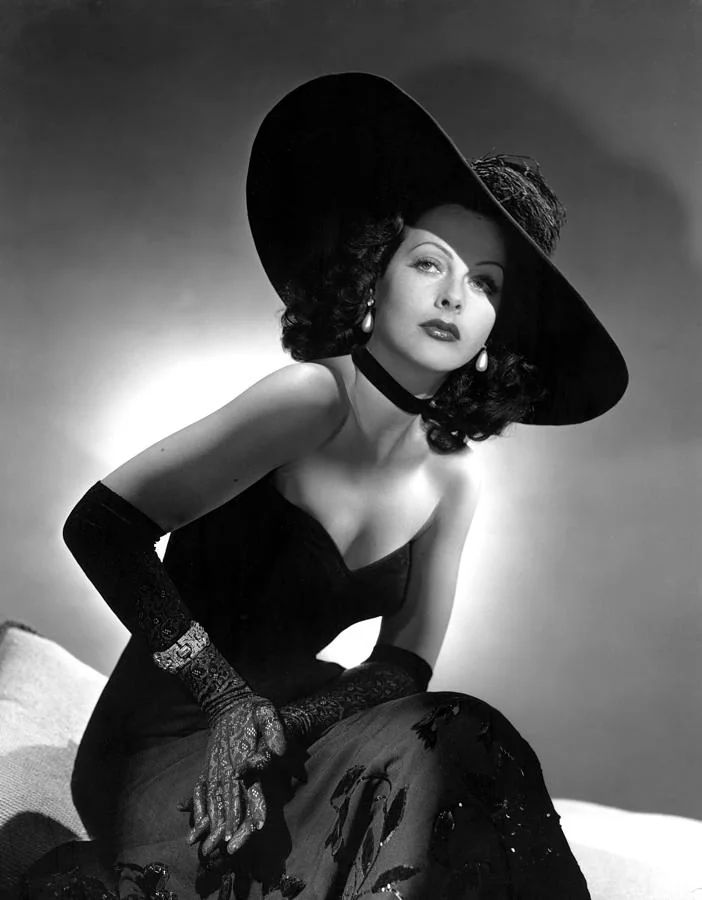
The Mother of Modern Wireless: Hedy Lamarr and the Technology That Changed Parenting (and the World)
Born in Vienna, Austria, on November 9, 1914., Hedy Lamarr was both an actress and a self-taught inventor. While she became famous in Hollywood during the 1930s and 1940s, her most impressive contribution came during World War II, when she partnered with composer and inventor George Antheil to create a revolutionary communication system.
Hedy Lamarr’s passion for science and invention started in her early childhood in Vienna, Austria. The key influence was her father, Emil Kiesler, a bank director who was deeply curious about technology and mechanics. As an only child she received a lot of attention from him. He would take her on long walks through the city and explain how everyday machines worked, things like printing presses, streetcars (trams), trolleys, power plants, and other devices. These conversations encouraged her to think analytically about the world around her.
From a very young age (as early as 5 years old), this parenting style led her to hands-on experimentation: she dismantled her music box (a player-piano-like device) to understand its inner workings and then reassembled it back. Biographers (like Richard Rhodes in Hedy’s Folly) describe this as an “inborn” fascination that her father actively fostered, he loved her curiosity and encouraged her to impress him with her ideas and fixes.
Her mother, Gertrud (a concert pianist from a Hungarian-Jewish family), supported her artistic side with ballet, piano lessons, and exposure to the arts/theater from a young age, but the scientific curiosity came mainly from her father.
Hedy Lamarr had no formal scientific or engineering education, she was a self-taught accuratelly observing her life. Her first husband’s (arms dealer Fritz Mandl) business circles exposed her to advanced military technology. Hollywood figures like Howard Hughes fueled her innovation by providing equipment and appreciating her inventive mind (e.g., she sketched airplane wing designs for him). Wartime motivations during WWII, where her knowledge of torpedoes (from her marriage) combined with her inventive drive led to the famous frequency-hopping patent with George Antheil.
In short, her passion was supported from childhood by her father’s enthusiastic explanations and encouragement of her natural curiosity, no formal schooling, but a home environment that encouraged asking “how things work” and fixing problems creatively. This foundation carried her through acting fame and into groundbreaking inventions.
The Hidden Genius Behind the Glamour
Hedy Lamarr experienced early fame in European cinema but later escaped a troubled marriage (to Austrian arms dealer Fritz Mandl) and moved to the US. After moving to the United States, she pursued acting in Hollywood but continued nurturing her passion for science and engineering in private.
In 1942, Lamarr and Antheil patented what they called a “Secret Communication System.” Their invention introduced the concept of frequency hopping, a technique that rapidly switches radio frequencies during transmission.
At the time, radio-controlled torpedoes were being developed for wartime use, but enemies could easily jam their signals. Lamarr and Antheil sought to solve this by designing a system that could make radio signals virtually impossible to intercept.
Instead of sending signals through a single radio channel their system would jump between 88 different frequencies in a pattern synchronised between transmitter and receiver. The idea was inspired by playing the piano, where paper rolls control musical notes automatically.
Although the U.S. Navy initially ignored the invention, the concept later became foundational for modern wireless security and signal reliability.
From Wartime Innovation to Parenting Technology
Today, Hedy Lamarr’s invention directly influences technologies that matter to modern families:
- Wi-Fi networks use similar spread-spectrum communication methods.
- Bluetooth devices rely on frequency hopping to reduce interference.
- Secure wireless baby monitors and smart home devices use similar signal security concepts.
For many mothers, this technology quietly supports everyday life, streaming educational content, monitoring babies remotely, or staying connected with family.
Recognition Came Late, But It Did!
For decades, Hedy Lamarr received little credit for her scientific achievements. She was primarily celebrated for her film career rather than her engineering mind. Only later in life did scientific communities begin acknowledging her contribution to communications technology.
In 1997, she and Antheil were awarded the Electronic Frontier Foundation’s Pioneer Award, recognizing their work as foundational to modern digital communication.
Why Her Story Matters for Mothers Today
Hedy Lamarr’s story is especially meaningful in parenting and womanhood context because it challenges traditional expectations. She demonstrated that women could be both creative and scientifically brilliant, even in eras that discouraged women from pursuing careers. Her parents encouragement on understanding the world from a detailed and very authentic perspective build love and self esteem to further achievements.
Her life reminds parents today that curiosity, creativity, and intelligence can coexist with family life, career goals, and artistic expression.
Though she passed away in 2000, Hedy Lamarr’s legacy continues powering the invisible infrastructure of modern technology. Every time a parent checks a baby monitor over Wi-Fi or pairs headphones to a phone, they are using technology built on her pioneering ideas.