Ever had one of those moments where someone looks at you and says, “What’s wrong?” and you genuinely don’t know how to answer… You feel nothing but emotional chaos, you know you’re something, not quite angry, not exactly sad, definitely not happy, but you can’t quite put your finger on it.
To be honest, most of us, millennials were never really taught the emotional intelligence. We got “happy,” “sad,” maybe “angry,” and then were sent off into adulthood expected to build relationships, careers, and motherhood with a vocabulary of about five feelings. No wonder things get messy, actually it’s surprising we still manage up to this point!
That’s exactly where Gloria Willcox’s Feeling Wheel becomes handy. Her work is based on earlier psychological ideas about emotion structure, including Plutchik’s Wheel of Emotions, who organised emotions into core feelings and blends, like a map of how emotions mix, intensify, and interact.
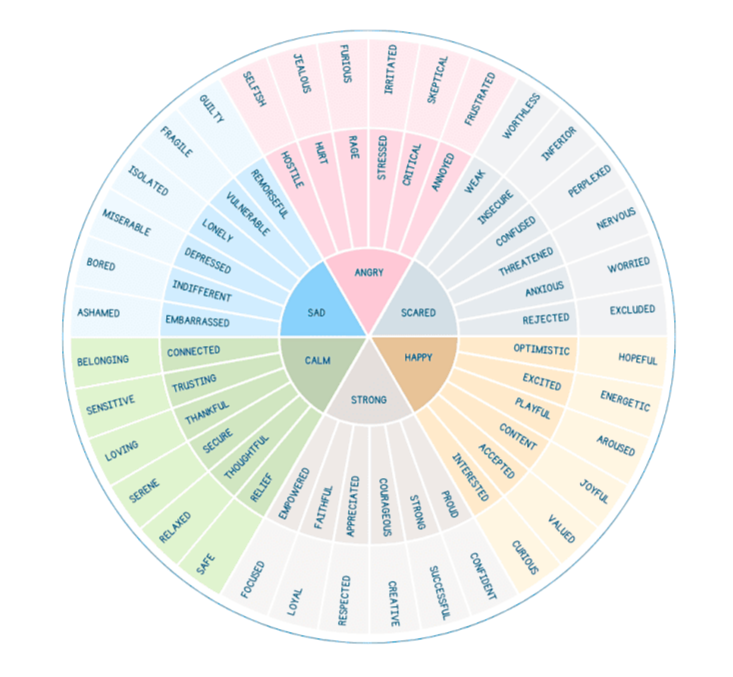
Expanding Emotional Vocabulary by Using Wheel of Emotions
Emotional chaos usually isn’t one big feeling, it’s several smaller ones happening at once. The Feeling Wheel is a simple visual tool that helps people move beyond basic emotional labels.
Instead of stopping at “I feel bad,” it helps you zoom in to:
- The inner circle: core emotions like happiness, sadness, anger, fear, etc.
- The outer layers: more specific feelings like frustrated, anxious, lonely, overwhelmed, insecure, hopeful, or relieved
It works like emotional clarity in layers: you start broad, then gradually get more precise about what you’re actually experiencing.
When we don’t have words for these layers, our brain compresses everything into one vague label: I feel bad. And “bad” doesn’t get us tools to understand.
Plutchik’s model invites us to see emotions as intelligent biological signals, and read them that way. Here’s a practical way to look at what each core emotion is “asking for”:
HAPPINESS → linked to experiences that support survival and well-being (connection, nourishment, success) and helps you build and maintain relationships and resources.
What this feeling is asking for:
- seek connection
- repeat positive experiences
- engage and play
SADNESS → encourages slowing down and reflection.
Sadness appears when something meaningful to you is lost or doesn’t go as expected.
What it needs:
- time – slow down
- reflect on what happened
- seek comfort or support
Not fixing. Not rushing. Just allowing to reflect on what happened
FEAR → protects you from danger
Fear activates survival responses in the body – fight, flight, freeze.
What it signals about:
- needs safety (physical or emotional)
- requires more information or clarity
- prepares to act quickly
Sometimes fear is accurate. Sometimes it’s outdated. Either way, it needs to be listened to before it can settle. Fear helps you recognise and identify risk and stay safe.
TRUST → supports bonding and relationships
Trust allows people to form stable, cooperative relationships. Trust signals: “I feel safe enough to open up or rely on this.”
What it signals about:
- open up to others
- rely on people and build closeness
- focus on relationships
When trust is present, connection deepens. When it’s broken, other emotions (like fear or anger) step in. Trust is essential for attachment, parenting, and social stability.
ANGER → helps you deal with obstacles
Anger arises when something blocks your goals or crosses your boundaries. Anger is one of the most misunderstood emotions, but it’s very useful. It says: “Something isn’t right.”
What it signals about:
- introduces boundaries
- requires expression (not suppression or explosion)
Healthy anger leads to clarity and self-respect. Ignored anger often turns into resentment.
It helps you protect yourself and restore balance or fairness.
STRENGTH → empowers you feel stable and intentional
Strength is what anger looks like once it’s understood and managed. Even if the situation is difficult, there’s a feeling of: “I can deal with this without falling apart.
What it signals about:
- Achieved comfortable emotional regulation
- Organised, and not chaotic emotions
- Ability to pause
Feeling strong signals that your internal system is balanced enough to handle what’s in front of you.
This wheel suggests the inner circle with six primary bipolar emotions: happiness versus sadness; calm versus fear; strong versus angry. The mid layer specifying and giving more clarity to the primary emotion and the outer layers: more specific feelings like frustrated, anxious, lonely, overwhelmed, insecure, hopeful
This wheel helps to get from vague to specific, and that’s where emotional clarity and emotional intellect begins.
How to Use the Feeling Wheel
Start at the center of the wheel and identify which general emotion fits best today. Are you feeling more like sadness, anger, calmness, or something else?
Then move outward toward the edges and get more specific. Which word feels closest to what you’re experiencing right now? If you’re unsure, try eliminating the ones that clearly don’t fit, this alone can guide you to the right one.
Once you find a word that resonates, say it out loud:
“I am feeling…”
Then pause for a moment and notice:
- where it shows up in my body
- what thoughts come with it
- how it feels when you give it attention
Research consistently shows that simply naming your emotions helps regulate them. Studies from institutions like UCLA have found that putting feelings into words reduces their intensity and makes them easier to manage. When you separate emotions, what felt like chaos becomes something structured, and much easier to respond to.
What to do after you identify the emotion
Once you’ve named what you feel, the next step is not overthinking, it’s understanding.
Ask yourself:
- What is this emotion telling me?
- What do I need right now?
- What is the exact opposite emotion and what do I feel about the opposite emotion.
Feeling wheel is not a tool to fix emotions it’s only to help you understand them. Because when you say: “I’m not just sad, I’m actually feeling lonely, and bored.” You’re no longer stuck in emotional chaos. You’re starting to make sense of it. And that’s where things begin to look better.