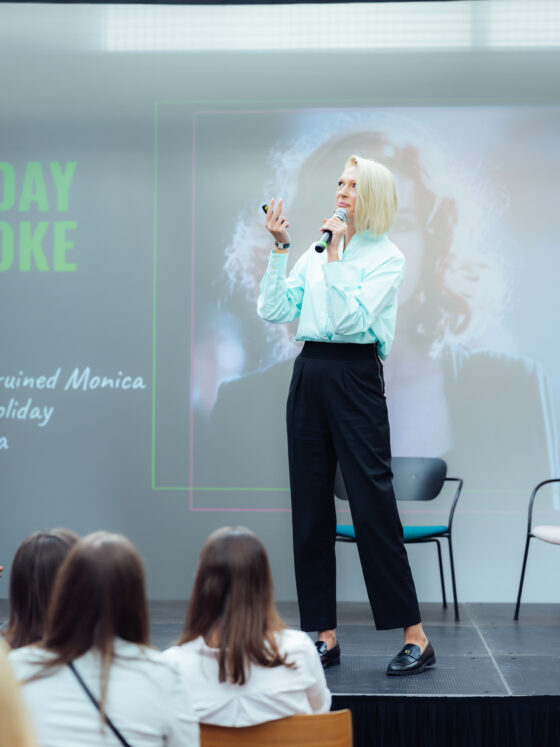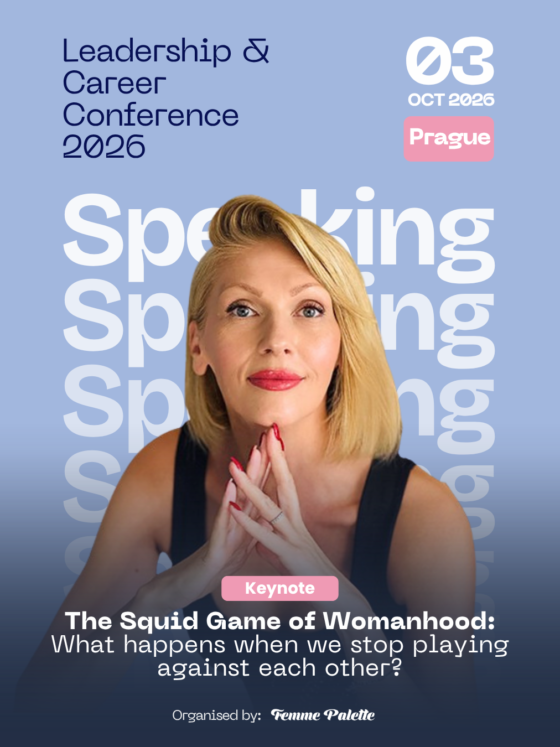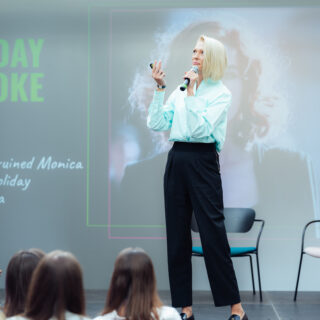
A little over a week ago, I stood on a stage in Prague, speaking to a room full of women about female competition, ambition and the rules we have inherited about how much space women are allowed to take. My talk was called The Squid Game of Womanhood and the One-Chair Trap. Twenty minutes of psychology, history, some uncomfortable observations and quite a few laughs.
Afterwards, women came to speak to me. Some shared their own experiences, others wanted to discuss particular ideas, and a few told me they had never really considered female competition from that perspective before. In the following days, I received many posts or private messages on LinkedIn and Instagram. One woman wrote about a question from my talk that had stayed with her. Another recognised the uncomfortable feeling of comparing herself with another woman’s success. Someone else told me how much she enjoyed the talk and encouraged me to keep doing what I do.
I had spent months reading, consulting other women, researching and developing my arguments, travelled to another country, shared what I had learned and watched some of those ideas travel further. I didn’t make a viral video. I didn’t dance one of those silly dances in front of a camera. No trending audio either. Just people talking to people.
And it got me think about how strangely we have come to understand the word influence.
When did influencing become a career before having something to say?
In 2023, a Morning Consult survey found that 57% of Generation Z respondents aged 13–26 would become social media influencers if given the opportunity. A later survey reported a similar level of interest. Apparently, influencing has become a perfectly respectable professional ambition.
I have worked in marketing for years. I understand the commercial value of an audience, and I certainly wouldn’t diminish content creation as a profession. Good creators are often excellent communicators, researchers, entertainers and businesspeople. But there is something about the ambition to become influential that bothers me. Influential about what, exactly? I mean, how often we encourage young people to think about what they would like to know, understand, investigate, challenge or contribute before encouraging them to think about how many people they would like to reach.
Apparently, even professionals have to dance now
Somewhere not that long ago, social media stopped being an additional communication channel and started becoming a rather demanding employer. Psychologists, doctors, lawyers, academics, business consultants, educators… everyone seems to have received the same memo.
Be visible.
Be relatable.
Post regularly.
Show your personality.
Follow the trends.
Make Reels.
Ideally, do something funny.
Stop making reels, focus on carousels.
And ideally, explain twenty years of professional knowledge in less than 20 seconds while pointing at floating text above your head.
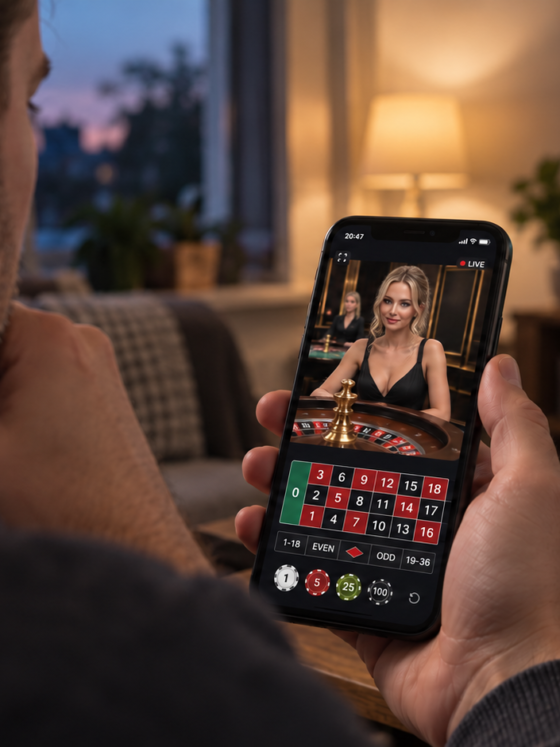
Why, please tell me why so many great professionals now feel obliged to become entertainers to have their expertise noticed but someone scrolling while sitting on the toilet.
From a Critical Social Psychology perspective, our behaviour doesn’t develop independently of the social environments in which we participate. What we consider normal, desirable or successful is influenced by cultural expectations, economic interests and existing power structures.
Researcher Brooke Erin Duffy explored this in her 2017 book Not Getting Paid to Do What You Love, introducing the idea of aspirational labour. She describes how social media creators invest enormous amounts of time and often unpaid work into building an audience, with the hope that visibility will eventually translate into professional or financial opportunities.
The interesting part is how fast this work became normalised. In a few years we learned treating hours spent producing content, monitoring analytics, following trends and maintaining a digital identity as a real job.
You’re not posting enough.
You’re not showing your face.
You’re not showing your unpolished life with messy bed and dirty kitchen
Your content isn’t relatable.
aaaaaaaaaaaa!!!!!
Suddenly, a perfectly competent professional might start questioning their 20 years of work because their last Reel received 300 views. What an extraordinary way to (d)evaluate someone’s exsistance.
Of course, professionals have always needed to communicate their work. Public speaking, publishing, networking and marketing existed long before Instagram. But things changed when professional credibility becomes so closely connected to the ability to attract attention.
A thousand views, but what exactly have we achieved?
My marketing brain finds this very interesting. Businesses spend considerable time discussing reach, impressions, engagement rates, followers and video views. And these metrics do have their uses. But shouldn’t we just ask: Did someone learn something? Change their mind? Trust the professional more? Book an appointment? Start a conversation? Make a decision?
Or did they watch three seconds of a video before moving on to another one?
Social media marketers commonly distinguish between reach, engagement and conversion, yet in our heads these measures get mixed together easily. A million views sounds impressive. But a million views tell us almost nothing about the depth of attention, the quality of the audience or whether any meaningful action followed.
There is also no credible universal conversion rate for trending videos. Conversion depends on what is being offered, to whom, on which platform and what action we are measuring. A viral comedy Reel, a lawyer’s educational video and a consultant’s invitation to book a session cannot reasonably be evaluated against one single percentage.
Suppose a professional spends three hours creating a trending video that receives 20,000 views but produces no enquiries, conversations or meaningful professional relationships. Now imagine the same professional spends those three hours speaking to fifteen people at a small event, answering their questions and discussing problems they are genuinely interested in solving.
Which activity was more influential?
The video may help establish familiarity, and some of its effects may appear months later. But the small event might result in five serious conversations, two professional opportunities and one person making a decision that genuinely improves their life.
There is another problem with measuring influence exclusively through online metrics: some of the most important effects are never recorded.
How do you calculate the conversion rate of a conversation between two friends? What percentage do we assign to a colleague who changes her opinion after hearing a different perspective? How do we measure the woman who goes home after a conference and starts questioning a belief she has held for twenty years?
I have no idea. But it sounds big to me.
Are we searching for meaning or reassurance that we matter?
Viktor Frankl would argue that human beings have a fundamental drive to find meaning. His approach emphasises meaning through what we contribute, what we experience and the attitudes we choose when facing circumstances we cannot change.
He also introduced the concept of self-transcendence: directing ourselves towards something or someone beyond our own immediate interests. Looking at influencing through this perspective raises a few uncomfortable questions: When we share something online, what exactly are we seeking?
Do we want to teach, entertain, inspire, sell, challenge an idea or contribute to a discussion?
Do we want recognition for our work, or to feel that our experiences matter. Perfectly human.
And sometimes, perhaps, we just want people to look at us. I don’t think we need to pretend otherwise. We have always enjoyed attention. We dress up, tell stories, celebrate achievements and occasionally exaggerate how wonderful our holidays were.
There is nothing especially shocking about exhibitionism or attention-seeking in its everyday, non-clinical sense. Wanting to be seen is part of being social.
The problem begins when we start relying on that attention to decide how much our lives are worth. A 2017 study by Stapleton, Luiz and Chatwin, involving 237 young adults, found that the relationship between Instagram use and self-esteem depended partly on how strongly individuals based their self-worth on other people’s approval. Their findings suggest that social comparison is particularly relevant when external validation already plays a significant role in someone’s self-evaluation.
More recent research has continued examining this relationship, including evidence that social media feedback can influence self-esteem, although effects vary between individuals and contexts.
So I wonder whether some forms of pseudo-influencing provide temporary relief from a much more ordinary human fear. The fear of being not liked. We post -> Someone likes it -> We feel noticed -> A few hours later, we check again.
There is always another trend to follow, another photograph to upload, another opportunity to remind the world that we exist.
But what responsibility are we fulfilling with our time? I don’t think every activity must be productive. Enjoyment, play, beauty and relationships can all be meaningful experiences. Sometimes making a silly video with friends is a wonderful use of your common time. But if we spend hours each week trying to convince strangers that our lives are interesting, we might ask whether we are enjoying those lives ourselves. Would we still choose to do it if nobody could see it?
Your social media can simply belong to you
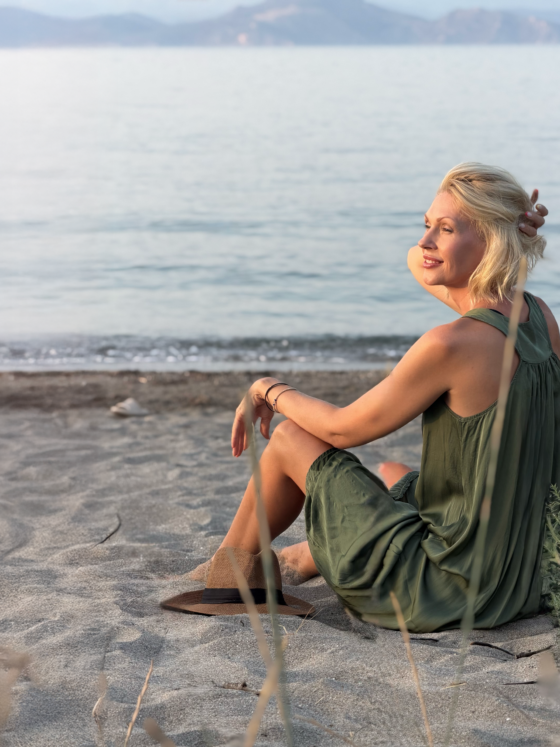
After all my criticism, I actually love social media. I enjoy photography, beautiful compositions, documenting places I visit and sharing little pieces of my life with people I don’t get to see. Having lived in several countries, my friends and family are scattered across Europe. Social media gives us a lovely way to remain part of one another’s lives, even when we haven’t shared a physical space for years.
And hey, I am no different from all other women – I like to drop a good shot of mine and receive attention, just to make sure my 42 years body and skin is still valid 😀 Sometimes I share things because they are beautiful. Sometimes because I am proud. Sometimes because I want to make someone laugh. And sometimes because I rather like receiving a compliment.
I also like looking back at old photographs and posts. They remind me of experiences I might otherwise forget. A little restaurant, a city I visited, something funny my daughter said, a moment when I felt particularly happy.
Social media can be a creative space, a visual diary, a way of communicating with friends, a business tool, or simply a place to enjoy ourselves.
It can serve several purposes at once. I just don’t want it to become the highest authority that decides whether my personal or professional life is successful.
If I give a speech and nobody posts about it, the speech still happened.
If I have a wonderful holiday and upload no photographs, I still had a wonderful holiday.
If I spend an afternoon reading something that changes how I previously understood something, that knowledge doesn’t become less valuable because nobody took a picture of me reading.
The conversations nobody will ever count
Going back to Prague, the part I value most wasn’t the photographs of me standing on stage. Although I do love them. It was the conversations that followed.
Women who approached me with their own life stories. People who challenged a point or wanted to explore it further. The continuation of discussions I had hoped to start when I first began preparing the talk.
Quite a few conversation even developed into an opportunity to work more closely with someone.
And I keep thinking about the possibility that another woman might have gone home, told a friend about something she heard and started a conversation that was much needed for their frienship.
I’ll probably never know.
Most of us have been influenced by people who have absolutely no idea what effect they had on our lives. A teacher who said something at the right moment. A colleague who carelessly dropped a compliment. A friend who introduced us to a book. A specialist who showed a different way of responding to a difficult situation.
None of these interactions got views or likes. They weren’t some famous influencers.
And you don’t need to become an influencer to influence people. You can influence people around yourself through ordinary decisions: whose ideas you support, whose achievements you recognise, how you respond to another woman’s success, and what conversations you are willing to have.
We can also influence people by knowing what we’re talking about. Reading. Studying. Listening. Questioning our own assumptions. Having the patience to develop ideas rather than rushing to package every thought into a 20 sec video with a 2 second hook.
And again, don’t get me wrong, I scrolled through some funny videos while writing this, there are brilliant creators doing valuable work, and there are people whose online content has had a great influence on how others understand the world. But I would like us to become a little less impressed by visibility alone.
A large audience can be useful. But so can an audience of three!
As for me, I’ll continue sharing my work, my cats, my photos, occasional opinions and probably far too many pictures from the places I just moved in.
But I’m starting to think that the most valuable influence I will ever have won’t come with an engagement report.
Don’t forget to share, hahah!