Pamela Anderson’s No-Makeup Look and the Psychology of Ageing
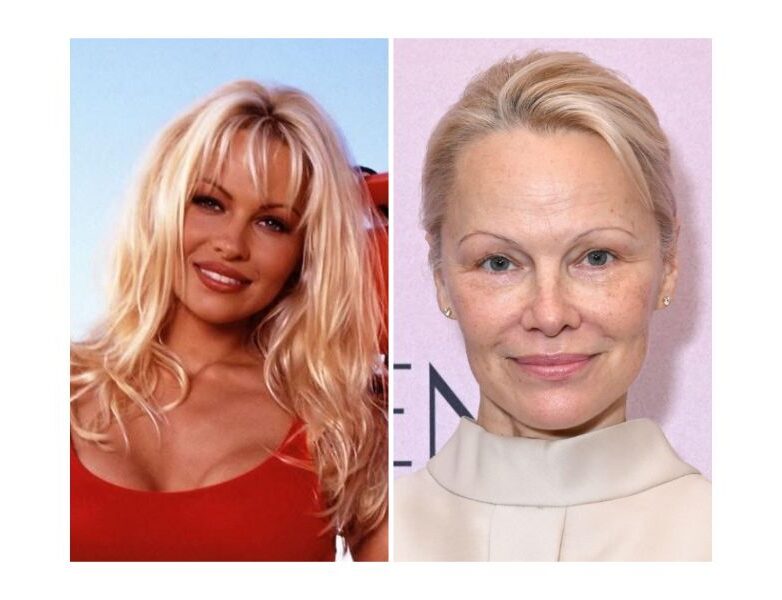
I grew up in a generation where Pamela Anderson was the ultimate symbol of what was sexy: blonde hair, big breasts, tiny waist and that famous red Baywatch swimsuit. Whether we wanted to look like her or not, we for sure knew what she represented.
And now, some 30 years later, here she is again. Same woman, same generation of women watching her, only this time she’s being celebrated for almost the exact opposite: bare skin; visible wrinkles; “natural-looking” skin. People are talking, magazines are writing about how absolutely stunning she ages, how brave she is and confident she looks.
I agree. With all of the above. But something about this “empowering” makes me uncomfortable. After spending our twenties feeling that we weren’t beautiful enough, are we now supposed to spend our forties and fifties feeling that we’re not ageing beautifully enough either?
Jung’s Stages of Life: Why Being Admired Matters More When We’re Young
Carl Jung’s essay The Stages of Life offers an interesting way to understand why beauty standards can become so deeply imprinted in our identities. Jung argued that much of the first half of adulthood is about establishing ourselves in the external world. We build professional identities, form relationships, seek independence, recognition, build families and learn how to function well within society.
And, naturally, we want to belong.
Wanting to be accepted, attractive and admired isn’t necessarily evidence of insecurity or vanity at this life stage. We’re social creatures. Other people’s responses help us understand where we fit in, how we’re seen and, sometimes, how we see ourselves. For young women, attractiveness can become overly important because society repeatedly teaches us that appearance affects how desirable, successful and socially valuable we are.
Jung called the social identity we develop and present to the world the persona. And while developing a persona is a normal part of social life, the danger comes when we begin confusing that social identity of ours with our entire personality.
For my generation, Pamela Anderson was the most visible version of the desirable female persona. I remember being 178 cm tall and weighing around 50 kg as a teenager. Mostly elbows and knees. Believe me, I looked the opposite of Pamela Anderson. And even though I never really imagined becoming her, I understood well what kind of female body was considered sexy. And came to the conclusion that I am not a sexy type. That’s how social expectations work. We don’t necessarily have to agree with them to be influenced by them.
But Why Do We Keep Comparing Ourselves?
Psychologist Leon Festinger’s social comparison theory proposes that we understand ourselves partly by comparing ourselves with others. Comparison helps us understand our abilities, achievements and social position. It can motivate us, provide information and help us establish our identities. But comparisons become complicated when we repeatedly measure ourselves against people who possess qualities we understand as superior. A 2025 meta-analysis of 83 studies involving 55,440 participants found a correlation between social comparison on social media and increased body-image concerns.
Now, if at 20, Pamela Anderson represented a standard of sexual attractiveness that many women couldn’t realistically reach. Now, at 59, she represents a woman who seems to have accepted ageing, rejected heavy makeup and somehow remains extraordinarily beautiful.
The message looks healthier: Embrace your wrinkles. Stop hiding your age. Be yourself.
Except that the example we’re being given is still Pamela Anderson!
We couldn’t look like her with full make up on when we were young. Now we’re being encouraged to look like her again but this time with “no make up on”. So what happens when we do everything we’re suggested to do and still don’t look far from the woman being celebrated?
Jung’s Second Half of Life: When Our Priorities Are Supposed to Change
Jung proposed that the psychological tasks of the second half of life cannot be a continuation of those of the first. In younger adulthood, we’re overly focused with establishing ourselves, getting recognised and meeting external expectations. But somewhere around midlife, according to Jung, we should begin questioning whether the identities and ambitions we’ve developed still reflect who we are now.
Now think about what this might mean for a woman whose looks has been the most important part of her identity for decades. Maybe she spent her twenties wanting to look attractive, her thirties trying to maintain that attractiveness and her forties worrying about losing it.
And just when she might begin reconsidering the importance of appearance in her life, society introduces a new standard for how an attractive mature woman should look. Naturally beautiful. Confident. Radiant. Ageing gracefully.
And that itself, even if it’s presented like encouragement and dipped in all possible natural trends may be encouraging women to continue pursuing the very thing Jung believed we might need to reevaluate: our dependence on external recognition.
And here’s something important to mention: neither Jung nor I am suggesting that mature women should stop caring about their looks. Many women continue to enjoy fashion, beauty and sexuality throughout their lives, and I certainly count myself among them. There’s absolutely nothing wrong with wanting to look and feel attractive, whatever our age. The important thing is to understand that being attractive is only one of the many things that make us feel valuable, and to encourage ourselves to discover new sources of self-worth as we grow older.
Psychologists Jennifer Crocker and Connie Wolfe (2001) developed the concept of contingencies of self-worth. Their theory explains that our self-esteem depends partly on the areas of life in which we invest our sense of personal value. For some people, that’s academic or professional achievement. For others, approval, relationships, morality or beauty.
When our self-worth depends heavily on your beauty, looking good makes you feel valuable, while feeling unattractive threatens how you feel about ourself. When looks and styles stop being something we enjoy and becomes something we need in order to feel worthy we face a problem.
Fredrickson and Roberts’ (1997) objectification theory explains how women can internalise an outsider’s perspective on their appearance and begin habitually monitoring their own bodies. And this constant monitoring has potential psychological costs: body shame, anxiety and reduced attention to internal experiences.
When Compliments Reinforce the Standards We’re Trying to Challenge
There’s one more thing I wish to cover here, the complements. We’ve finally become aware that criticising women’s bodies can damage their confidence. Many of us are trying to be more careful about commenting on weight, age and looks. But we rarely question our positive comments. “Pamela looks incredible without makeup!”; “She’s showing us how to age gracefully!”; “She looks better now than she did at 30!”
But what if she had deeper wrinkles, thinning hair, uneven skin and facial features that are commonly seen as not so attractive? Would her bare face still be celebrated as revolutionary? Or does natural ageing only become inspirational when the woman doing it is beautiful enough to make it look desirable? In other words: would we be equally enthusiastic if she looked like an entirely ordinary 59-year-old woman?
From a critical social psychological perspective, this matters because beauty standards aren’t maintained only through criticism and discrimination. They’re also reinforced through admiration, social approval and the qualities we repeatedly reward. We don’t have to tell women they’re unattractive to make them feel that attractiveness is extremely important. We can do it by constantly celebrating beautiful women.
And I’m not suggesting we should stop giving compliments.
But maybe we should become more conscious of what we’re really saying when we do.
Maybe Pamela Anderson Has Changed. But Have We?
Pamela Anderson herself has explained that wearing less makeup has been a personal choice, not a rejection of cosmetics. She’s written a memoir, pursued creative interests and spoken about wanting to explore who she is beyond the looks that made her famous. From a Jungian perspective, that’s the far more interesting part of her transformation we could be talking about. Not the absence of mascara. But until someone figures out how to package and sell wisdom, we’ll keep talking about anti-ageing creams and the secret to glowing skin instead.
But Pamela Anderson doesn’t owe us a perfect example of natural ageing. And her decision to wear “less” makeup shouldn’t become a standard that other women feel obliged to follow.
She can be beautiful. She can enjoy being beautiful. She can wear makeup tomorrow and none the day after. But the rest of us should be comfortable aging without having to look like Pamela Anderson, either the 1990s version or the 2026 one. Because after all the life goal shouldn’t be to age as beautifully as possible. It should be to reach an age when beauty no longer has to carry so much of our self-worth.
References and Further Reading
1. Jung, C. G. (1969). The stages of life. In The structure and dynamics of the psyche (R. F. C. Hull, Trans., 2nd ed., Vol. 8). Princeton University Press. (Original work published 1931).
2. Jung, C. G. (1966). Two essays on analytical psychology (R. F. C. Hull, Trans., 2nd ed., Vol. 7). Princeton University Press.
3. Festinger, L. (1954). A theory of social comparison processes. Human Relations, 7(2). https://doi.org/10.1177/001872675400700202
4. Crocker, J., & Wolfe, C. T. (2001). Contingencies of self-worth. Psychological Review, 108(3). https://doi.org/10.1037/0033-295X.108.3.593
5. Fredrickson, B. L., & Roberts, T.-A. (1997). Objectification theory: Toward understanding women’s lived experiences and mental health risks. Psychology of Women Quarterly, 21(2). https://doi.org/10.1111/j.1471-6402.1997.tb00108.x
6. Dion, K., Berscheid, E., & Walster, E. (1972). What is beautiful is good. Journal of Personality and Social Psychology, 24(3). https://doi.org/10.1037/h0033731
7. Frankl, V. E. (2006). Man’s search for meaning. Beacon Press. (Original work published 1946).
8. Sontag, S. (1972). The double standard of aging. The Saturday Review, 55.